
The Biggest Lie in the Essential Oils Industry

Why Essential Oils Are About Far More Than Fragrance
If you've ever stood in front of a shelf full of essential oils and wondered why one bottle of lavender costs £2 while another costs £30, you're not alone.
This is one of the most common questions I get asked - and on the surface, it's a completely reasonable one. After all, if both bottles say "Lavender Essential Oil" on the label and both smell recognisably like lavender, surely they're basically the same thing?
Well, for many years, I probably would have asked exactly the same question, b ut after studying aromatherapy, working with essential oils clinically, and learning far more about how the industry actually works, I've come to realise that this question misses something incredibly important.
The value of an essential oil isn't that it smells like lavender. The value is that it is lavender.
And that distinction changes everything. Because if essential oils were simply fragrance products, none of this would matter. You could buy whichever bottle smelled nicest, enjoy the aroma and move on with your day.
But that's not why most people are interested in essential oils.
People use essential oils to support sleep, relaxation, focus, mood, stress management, emotional wellbeing, respiratory health and countless other aspects of everyday life.
In other words... people aren't simply looking for a pleasant smell. They're looking for the unique benefits that these remarkable plants can offer.
And that's exactly why quality matters.

The Biggest Lie
The biggest lie in the essential oils industry is that if an oil smells right, it must be right.
Most consumers buy with their nose and trust whats on the label.
If it smells like lavender, they assume it's lavender.
If it smells like peppermint, they assume it's peppermint.
If it smells pleasant, they assume it's high quality.
Unfortunately, scent alone tells us remarkably little about what is actually inside the bottle.
An oil can smell right and still be diluted.
An oil can smell right and still contain synthetic additions.
An oil can smell right and still be missing key constituents.
An oil can smell right and still have been reconstructed from isolated compounds rather than remaining as nature originally produced it.
The average consumer would never know. And that's precisely why this conversation matters.
Essential Oils Are More Than Fragrance
If essential oils were simply perfume, none of this would matter. But essential oils are chemically complex botanical substances. A single essential oil can contain dozens, and sometimes hundreds, of naturally occurring compounds. These compounds don't exist in isolation; they interact with one another in ways nature has spent thousands of years perfecting and we are still learning to understand.
This chemistry is what gives essential oils their unique properties and it's why people reach for lavender to calm and soothe, peppermint to cool and energise, frankincense to focus, ground and support cellular health or Wild Orange to uplift mood.
The benefits people seek from essential oils don't come from what's on the label or the marketing and they don't come from scent alone.
They come from chemistry.
This is why authenticity matters, because the value of lavender isn't simply that it smells like lavender. The value is that it contains the chemistry nature intended.

The Journey Nobody Sees
One of the most fascinating things I learned about the essential oil industry is what happens before an oil ever reaches the shelf.
Most consumers imagine a simple journey:
Farm → Distillery → Bottle
The reality is often far more complicated.
Many oils pass through multiple brokers, traders, wholesalers and suppliers before reaching the final brand. Along the way, oils are bought, sold, blended, standardised, diluted, altered, reworked and traded as commodities. And every step creates pressure. Pressure to reduce cost, increase margins and create a product that smells the same every time.
Because the truth is most consumers buy with their nose, or trust what's on the label. Not with the laboratory data, transparency or authenticity testing.
Just smell.
And that's where the industry's biggest lie thrives - that smelling right proves they're right. But sadly a reconstructed oil can smell right. An adulterated oil can smell right. An oil with synthetic additions can smell right. An oil missing key constituents can still smell right.
The average consumer would never know.
Which is why authenticity matters and what we're really going to get into in this article.

Nature Doesn't Make Identical Oils
One of the challenges with authentic plant products is that nature isn't perfectly standardised.
Plants respond to their environment - which of course is dynamic and forever changing.
Soil matters.
Climate matters.
Rainfall matters.
Altitude matters.
Harvest timing matters.
Distillation matters.
Lavender grown in one region won't have exactly the same chemistry as lavender grown somewhere else and one harvest year may differ subtly from another. much like what we find in the fine wine industry.
Nature creates variation. Industry often prefers uniformity.
One approach is to alter the oil itself by adding, removing or reconstructing components until it smells exactly the same every time (more on that below).
Another is to invest heavily in sourcing, testing and quality control so that natural variation is understood and managed without fundamentally changing the oil. This is one of the reasons I place so much value on companies that work closely with growers, invest in long-term sourcing relationships and perform extensive testing throughout the production process.
For example, one of the things that first attracted me to doTERRA was its commitment to sourcing. Through its Co-Impact Sourcing® model, the company works directly with growers and producers around the world, often developing long-term relationships that prioritise quality, sustainability and traceability.
When you know where an oil comes from, who produced it, how it was grown and how it was tested, you have far greater confidence in the integrity of what ends up in the bottle.
That's a very different approach from simply buying commodities through multiple layers of brokers and hoping for the best.
What Is Adulteration?

When people hear the word adulteration, they often imagine a completely fake product.
The reality is usually far more subtle.
Adulteration can involve:
• Diluting oils with cheaper materials
• Adding synthetic compounds
• Adding isolated constituents
• Removing valuable compounds
• Reconstructing aroma profiles
The result? An oil that still smells right but may no longer reflect what nature originally produced.
Imagine buying a Ferrari only to discover that the engine came from a Ford, the gearbox came from a Toyota and the wheels came from a scrapyard. It still looks like a Ferrari, but it isn't the Ferrari you thought you were buying.
The same thing can happen with essential oils. Some essential oils are reconstructed from isolated compounds rather than remaining as nature produced them, and because the scent still smells familiar, consumers often never realise the difference.

The Data We Can't Ignore
dōTERRA recently shared data (May, 2026) that evalutaed 6 years of testing across 303 samples and 28 essential oils brands currently on the EU market. They used chiral GC-MS, chemometric and ratio analysis to identify the most adulterated oils.
Here's what they found:
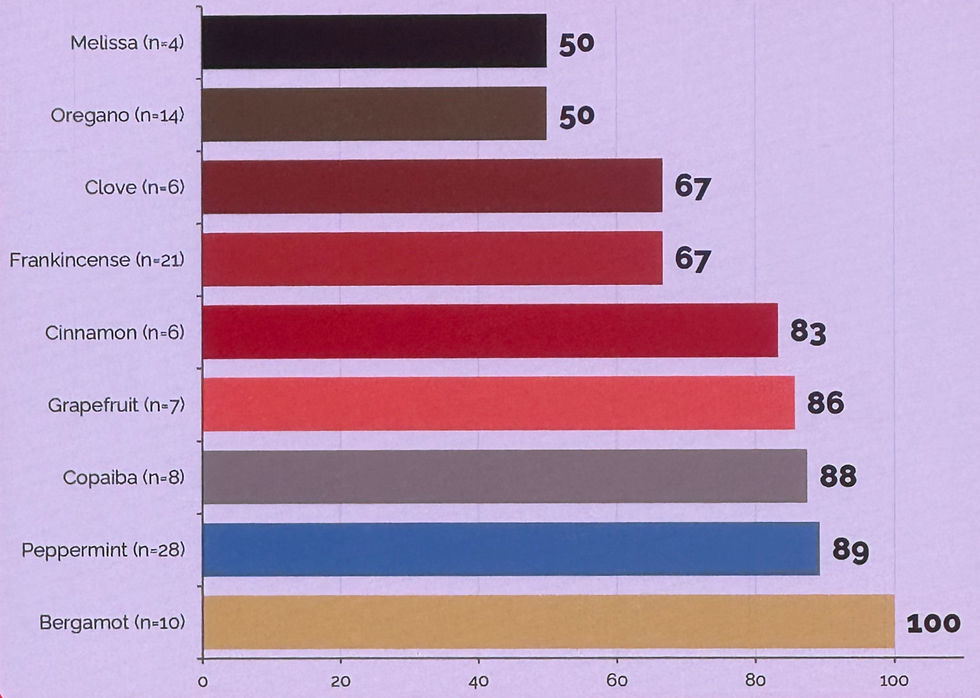
Evidence of adulteration was found in:
• 100% of bergamot samples tested
• 89% of peppermint samples
• 88% of copaiba samples
• 67% of frankincense samples
Regardless of how one interprets individual studies, the broader message is difficult to ignore: Authenticity is not something consumers should simply assume.
Why Companies Do It
One of the biggest misconceptions in this conversation is that adulteration only happens because companies are dishonest but the reality is often far more complicated.
There are two enormous pressures within the essential oil industry:
Cost.
Consistency.
Authentic essential oils are expensive to produce. It takes huge amounts of plant material to create even small quantities of oil. You'll notice from the data above that it is esepcially low-yield essential oils that are often are the ones most commonly adultered.
At the same time, consumers increasingly expect low prices and identical aromas.
Reconstruction and standardisation can solve both problems. They can make oils cheaper and they can make them smell the same every time. The challenge is that consistency of scent is not necessarily the same thing as authenticity of chemistry. And if you're using essential oils for their therapeutic potential, that distinction matters enormously.
Why Companies Don't Always Know
One of the most surprising things for consumers is that not every company intentionally participates in poor practices. Many companies never grow a single plant, may never visit a farm and often never distil an oil.
Instead, they rely on suppliers, brokers and wholesalers.
And without sophisticated authenticity testing, companies themselves may have limited visibility into what happened earlier in the supply chain. This is why transparency, testing and a desire on the company's part to care about looking more deeply into their supply chain matter so much.
Why Purity and Consistency Matter
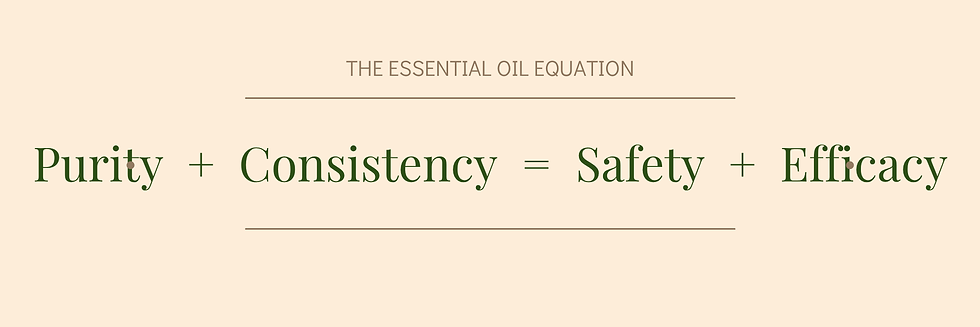
If you're using essential oils for more than fragrance, purity and consistency matter enormously.
Purity means the oil is what it claims to be. nothing added, removed or manipulated.
Consistency means the chemistry remains predictable from batch to batch. Predictable chemistry creates predictable outcomes.
Together they create the foundation for:
Safety.
Efficacy.
Trust.
Imagine if your medication changed every month.
One month it contained the expected active ingredients.
The next month it contained only 30% of them.
The month after that it had a different chemical profile altogether.
You would immediately question its reliability.
Yet many people expect consistent therapeutic results from essential oils without ever considering whether the chemistry inside the bottle is authentic and predictable.
If chemistry drives outcomes, chemistry matters.
And if chemistry matters, authenticity matters.
So What's The Alternative?

At this point, you might be wondering:
If nature creates variation, consumers expect consistency and adulteration is common, what's the alternative?
The answer isn't simply accepting poor quality. And it isn't necessarily accepting wildly inconsistent products either.
The real alternative is investing in sourcing, transparency and testing.
One approach to consistency, as we've seen, is to alter the oil itself by adding, removing or reconstructing components until it smells exactly the same every time.
Another is to invest heavily in sourcing, testing and quality control so that natural variation is understood and managed without fundamentally changing the oil. This is one of the reasons I place so much value on companies that work closely with growers, invest in long-term sourcing relationships and perform extensive testing throughout the production process.
For example, one of the things that first attracted me to dōTERRA was its commitment to sourcing. Through its Co-Impact Sourcing® model, dōTERRA works directly with growers and producers around the world, often developing long-term relationships that prioritise quality, sustainability and traceability.
Rather than treating essential oils as anonymous commodities traded through multiple intermediaries, this approach seeks to create visibility from farm to bottle. When you know where an oil comes from, who produced it, how it was grown and how it was tested, you have far greater confidence in the integrity of what ends up in the bottle.
That's a very different approach from simply buying commodities through multiple layers of brokers and hoping for the best. For me, this is where the conversation shifts.
Because the goal isn't simply avoiding adulteration.
The goal is preserving the authentic chemistry of the plant in the first place while respecting the people, communities and ecosystems that make that plant possible.
In my view, the very best essential oils don't just protect the integrity of the oil.
They protect the integrity of the entire journey from soil to bottle.
Why Marketing Claims Aren't Enough
One of the biggest surprises for consumers is that terms such as:
"100% Pure"
"Natural"
"Premium Quality"
"Therapeutic Grade"
can sound incredibly reassuring while telling us very little about what's actually inside the bottle. Many of these terms have no universally accepted regulatory definition.
That doesn't mean every company using them is being misleading but it does mean consumers should be cautious about assuming a label proves quality.
A label is marketing.
Authenticity is evidence.
The real questions are:
How was the oil sourced?
How was it tested?
How does the company verify authenticity?
Can they demonstrate what's actually inside the bottle?
How To Spot A High Quality Essential Oil
No single factor guarantees quality. However, there are several things I always look for.
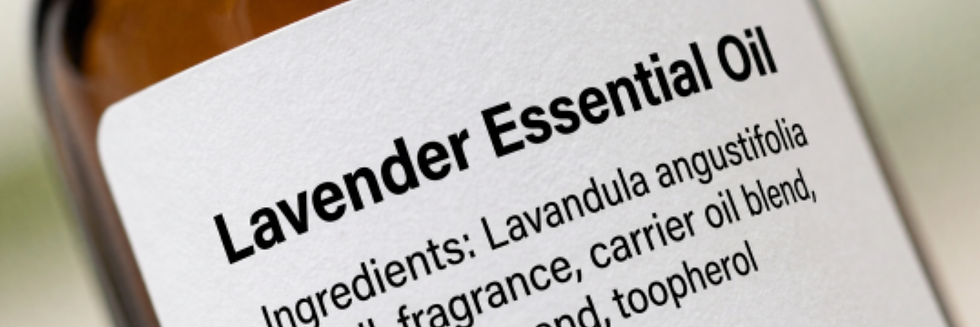
1. The Botanical Name
A quality company should clearly identify the exact species.
For example:
Lavandula angustifolia
rather than simply "Lavender."
Different species can have very different chemical profiles and therapeutic properties.
2. Transparency
Can the company tell you where the oil was grown?
Who produced it?
How it was distilled?
The more transparent the journey from farm to bottle, the easier it is to trust.
3. Testing
Authenticity testing is expensive, but it remains one of the most important safeguards in the industry.
Companies serious about quality should be able to explain how they verify identity, purity and composition.
4. Price That Makes Sense
Cheap doesn't automatically mean poor quality. But it should make you curious.
If one bottle costs a fraction of comparable oils across the market, it's reasonable to ask:
How was that possible?
Because authentic essential oils that care for nature and the people that grew and harvested them are resource-intensive to produce.
5. A Commitment To Chemistry
The best companies talk about chemistry, sourcing and authenticity. Not simply fragrance.
The Real Value of Essential Oils
The purpose of this article isn't to convince you that every expensive oil is excellent or that every inexpensive oil is poor quality.
The point is much simpler than that.
Essential oils have value beyond aroma and if you want access to that value, quality matters.
Not because luxury branding or pretty packaging matters, but because chemistry matters.
The question isn't:
"Does it smell like lavender?"
or even:
"Why is this bottle more expensive?"
The real question is:
"Am I experiencing everything lavender has to offer?"
Because that's where the true value of essential oils lies. Not in their scent alone. But in their authenticity, integrity and chemistry.
And that's a question worth asking before you buy your next bottle.
Want To Learn More?
If you've made it this far, I hope one thing has become clear: Essential oils have value beyond aroma and if you're going to use them for your health and wellbeing, quality matters.
My goal has never been to convince people that they need the most expensive oil on the market, but simply to help people understand what they're buying and why it matters.
As both a doctor and aromatherapist, I'm passionate about helping people use essential oils safely, confidently and effectively.
If you're curious about where to start, want help choosing the right oils, or would like to learn more about the oils I personally use and recommend, I'd love to hear from you.
You can connect with me on Instagram, reply to this article, or get in touch directly.
Because once you understand that essential oils are more than fragrance, the conversation changes completely... and that's where the real journey begins.


Comments