
3 Handmade Aromatherapy Gifts You Can Make from Your Home Apothecary


Three simple botanical gifts I made for my son's teachers - including foot bath melts, a body polish and homemade lip balm.
One of the unexpected joys of building a home apothecary is realising just how many useful things you can make with a relatively small collection of ingredients.
A bottle of carrier oil. A little beeswax. Shea butter. Salts. A handful of essential oils you know well.
Individually, they may not look particularly remarkable.
But once you begin to understand how to use them, they become the beginnings of balms, bath rituals, body oils, aromatic blends and thoughtful little gifts.
Which is exactly how I found myself in my kitchen recently, making end-of-year presents for my son's teachers and teaching assistants.
After a whole year of caring for, encouraging and supporting him, I wanted to give them something that felt genuinely thoughtful. And, perhaps more importantly, something that encouraged them to take a little time for themselves once the school doors finally close for summer.
So I made three simple gifts from my home apothecary.
Revive Foot Bath Melts.
A Reset Body + Foot Polish.
And little Rose Botanical Lip Balms, scented softly with lavender, geranium and of course the powdered rose petal.
Nothing complicated - and it didn't take forever either.
Just a few useful ingredients, some carefully chosen essential oils and the confidence to know how to put them together.
And honestly, this is exactly what I mean when I talk about building a home apothecary...
What Does It Actually Mean to Build a Home Apothecary?
I think the words home apothecary can sometimes conjure up images of enormous shelves filled with obscure herbs, hundreds of tiny bottles and remedies for every conceivable ailment.
Mine doesn't really look like that.
For me, building a home apothecary is much more practical. And it doesn't require you to be a master herbalist or an experienced aromatherapist either.
It's about slowly gathering a collection of ingredients you genuinely use and, importantly, learning enough about them to feel confident reaching for them.
Like which carrier oil you might choose for a balm or why beeswax changes the texture of a recipe. Recognising that peppermint, rosemary and tea tree create a very different aromatic experience to lavender and geranium. Learning about dilution and safe use.
...And gradually reaching the point where you can look at the ingredients you already have and think:
I could make something with this. I know how to support some of my family's needs with this.
These three gifts are a lovely example.
1. Revive Foot Bath Melts
Rosemary, Peppermint + Tea Tree
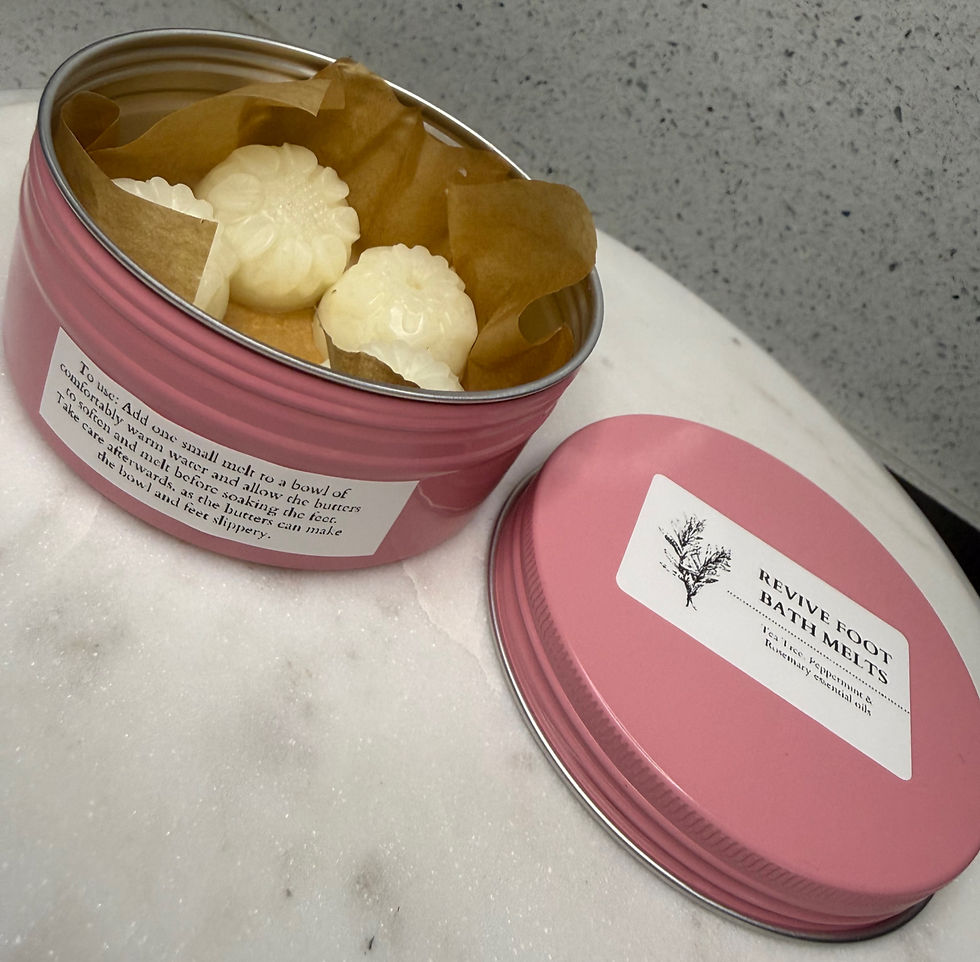
If ever there was a gift made for the final week of the school year, I think a foot bath might be it.
These little foot bath melts were designed to be dropped into a bowl of warm water at the end of a long day. I chose rosemary, peppermint and tea tree essential oils for a fresh, herbaceous aromatic blend that feels wonderfully clean and reviving.
Alongside their aromatic qualities, these oils are also valued for their antibacterial and anti-fungal activity, particularly welcome in a foot care blend, while the bright, invigorating aroma helps lift the senses and breathe a little life back into tired feet.
Revive Foot Bath Melts Recipe
Makes approximately 35+ small melts, depending on the size of your moulds.
You will need:
1 cup mango (or cocoa) butter
½ cup shea butter
½ cup Epsom salts
7 drops tea tree essential oil
3 drops peppermint essential oil
9 drops rosemary essential oil
Dried flowers, optional
Method:
Gently melt the mango butter and shea butter together over a low heat using a double boiler.
Once completely melted, remove from the heat and allow the mixture to cool slightly.
Add the tea tree, peppermint and rosemary essential oils and stir well to combine.
Stir through the Epsom salts.
Pour the mixture into small silicone moulds.
The Epsom salts will naturally begin to settle a little as you work. I find it helpful to use a small spoon to make sure the salts are divided fairly evenly between the moulds rather than leaving most of them at the bottom of the bowl.
If you like, you can add a small amount of dried flowers to each melt.
Transfer the moulds to the fridge and leave until completely set.
Once firm, remove the melts from the mould and store in a cool, dry container.
To use: Add one small melt to a bowl of comfortably warm water and allow the butters to soften and melt before soaking the feet.
Take care afterwards, as the butters can make the bowl and feet slippery.
A Little Aromatherapy NoteIt can be tempting to simply add a few drops of essential oil directly to a foot bath, but essential oils and water don't mix. These melts offer a gentler alternative: the essential oils are first diluted through the plant butters rather than being dropped neat into the water. The butters will still float as they melt, so I've kept the essential oil concentration low - but for a simple home foot bath, it's a much more thoughtful way to use them. |
2. Reset Body & Foot Polish
A Simple Aromatic End-of-Day Ritual

For the second gift, I made a pink Himalayan salt body and foot polish scented with dōTERRA's Adaptiv.
I deliberately wanted this one to feel different from the foot bath melts. The rosemary, peppermint and tea tree blend is fresh and reviving. This aromatic 'reset' scrub was intended to feel more like a pause. Something to scoop from the jar and massage slowly over tired feet or the body at the end of a long day.
I used dōTERRA's Adaptiv essential oil blend because I already knew the aromatic character I wanted here. Soft citrus, florals and herbaceous notes combine in a blend designed around moments of change and tension. And, honestly, I thought that felt rather appropriate for teachers reaching the end of another school year.
Reset Body & Foot Polish Recipe
Makes approximately six 3 oz jars, filled with around 2.5 oz of polish each.
You will need:
2 cups pink Himalayan salt
½ cup sweet almond oil
~40 drops dōTERRA Adaptiv essential oil blend (2% dilution)
Method:
Select your essential oil blend, in this case we already had Adaptiv essential oil blend ready, add to a large bowl.
Add the sweet almond oil to your essential oil blend and mix thoroughly
Stir in the pink Himalayan salt until everything is well combined.
Spoon into clean, dry jars and seal.
To use: Massage a small amount over damp skin, paying particular attention to rough areas or tired feet, before rinsing thoroughly. Avoid broken or irritated skin and take care when using an oil-based polish in the bath or shower, as surfaces may become slippery.
Why I Sometimes Use a Pre-Blended Essential OilThere can be a tendency in aromatherapy to assume that creating everything from individual essential oils is somehow more authentic. I don't think it has to be. Learning to formulate your own aromatic blends is a wonderful skill, and something I love doing. But a well-constructed pre-blended essential oil can also be incredibly useful in a home apothecary. In this case, I already knew the aromatic character I wanted the body polish to have. dōTERRA's Adaptiv gave me that beautifully. The important thing is still understanding the product you're using, checking the individual essential oils within the blend and considering whether it is appropriate for your chosen method of application. Convenience doesn't mean abandoning thoughtfulness. |
3. Rose Botanical Lip Balm
Lavender + Geranium

The final gift is one of my favourites. A simple botanical lip balm made with shea butter, beeswax and sweet almond oil.
For the aromatic blend, I used lavender and geranium. Just six drops across the entire batch. The result is soft, gently floral and deliberately subtle. Because aromatherapy doesn't always need to shout.
Rose Botanical Lip Balm Recipe
Makes six small lip balm tins comfortably.
You will need:
2 teaspoons shea butter
4 teaspoons beeswax pellets
6 teaspoons sweet almond oil
4 drops lavender essential oil
2 drops geranium essential oil
Optional: Vitamin E oil
Method:
Place the shea butter and beeswax pellets into a double boiler and melt gently over a low heat.
Once melted, add the sweet almond oil and stir thoroughly to combine.
Remove from the heat.
Allow the mixture to cool very slightly before adding the lavender and geranium essential oils. Stir well.
Working fairly quickly, pour the balm into six clean lip balm tins.
Transfer to the fridge and allow to set completely.
Once firm, add the lids and store somewhere cool and dry.
Why So Little Essential Oil?More essential oil doesn't necessarily make a better product. In fact, one of the most useful skills you can develop in aromatherapy is knowing when to use less. Lip products deserve particular thought because they are applied frequently and close to the mouth. Here, I wanted the essential oils to add a gentle aromatic layer to the balm rather than dominate it. The beeswax, shea butter and sweet almond oil are doing the practical work of creating the balm. The essential oils are there with a much lighter touch. And I think that's an important distinction. |
Three Gifts. One Home Apothecary.
When I lined the three finished gifts up on my kitchen table, I realised they captured something I've been trying to explain about home apothecaries for a long time.
You don't need hundreds of ingredients. You don't need to make everything from scratch. And you certainly don't need to become an expert in every medicinal plant before you're allowed to begin.
You start with a few good ingredients.
You learn about them.
You use them.
And then you use them again in a slightly different way.
The shea butter you bought for one project becomes part of a foot bath melt and then a lip balm. The sweet almond oil on your shelf becomes a body polish and a simple botanical balm. The essential oils you already know begin to find their way into practical, thoughtful things you can actually use.
Slowly, your collection of bottles and jars stops feeling like a collection of things. It becomes useful.
And for me, that is the real joy of a home apothecary. Not having the most impressive shelf, but having a home filled with ingredients you actually know how to reach for.
Ready to Build Your Own Home Apothecary?
If you've got a small collection of essential oils, maybe even some carrier oils and are drawn to botanical ingredients but aren't always quite sure what to do with them, you're exactly who I created Subtle Medicine for.
I'm Dr Lucy Connor, founder of Subtle Medicine.
A former NHS doctor, aromatherapist and lifelong lover of plants, I enjoy exploring where modern medicine, traditional herbal wisdom and everyday life meet.
Through Subtle Medicine, I share evidence-informed articles, seasonal recipes and practical inspiration to help you build confidence using medicinal plants and essential oils at home.
You don't need to know everything before you begin.


Comments