
Hinoki Essential Oil: The Quiet Wisdom of the Forest

Updated: Jul 5

"Some plants ask us to pay attention. Others simply invite us to be still."
There are some essential oils that announce themselves the moment you open the bottle.
Peppermint arrives with its bright clarity. Lemon sparkles. Frankincense carries a familiar sense of reverence. Hinoki does something different.
The first time I smelled it, I didn't immediately know what to make of it. It wasn't dramatic or particularly floral. Instead, it reminded me of walking through an old woodland after rain. There was a stillness to it. A sense that nothing needed to happen.
The more time I've spent with Hinoki, the more I've come to appreciate it. It isn't an oil that demands your attention. It simply invites you to slow down enough to notice.
Meet the Tree

Hinoki (Chamaecyparis obtusa) is a graceful evergreen conifer native to Japan and parts of central Taiwan. Although commonly called a cypress, it belongs to its own unique branch of the cypress family and has been treasured for well over a thousand years.
In Japan, Hinoki is one of the country's most revered trees. It has been used to build temples, shrines and traditional bathhouses, not simply because of its beautiful pale timber but because of its remarkable durability and naturally aromatic wood.
Walk into one of these buildings and you'll often notice the scent before anything else. Fresh Hinoki timber releases a soft, clean fragrance that has become part of the architecture itself. Even today, many traditional Japanese baths (onsen) are prized as much for their atmosphere as for their craftsmanship. The warm, woody aroma has become woven into the experience of rest and renewal.
Perhaps the most remarkable example of Hinoki's longevity is Hōryū-ji, one of the oldest surviving wooden structures in the world. Parts of this Buddhist temple complex date back to the seventh century and were built largely from Hinoki timber. More than 1,300 years later, they still stand as a quiet testament to the remarkable strength, resilience and beauty of this extraordinary tree.
Its fragrance has long been considered part of these sacred spaces, not something added afterwards, but something that naturally belongs there.
Hinoki Essential Oil at a Glance
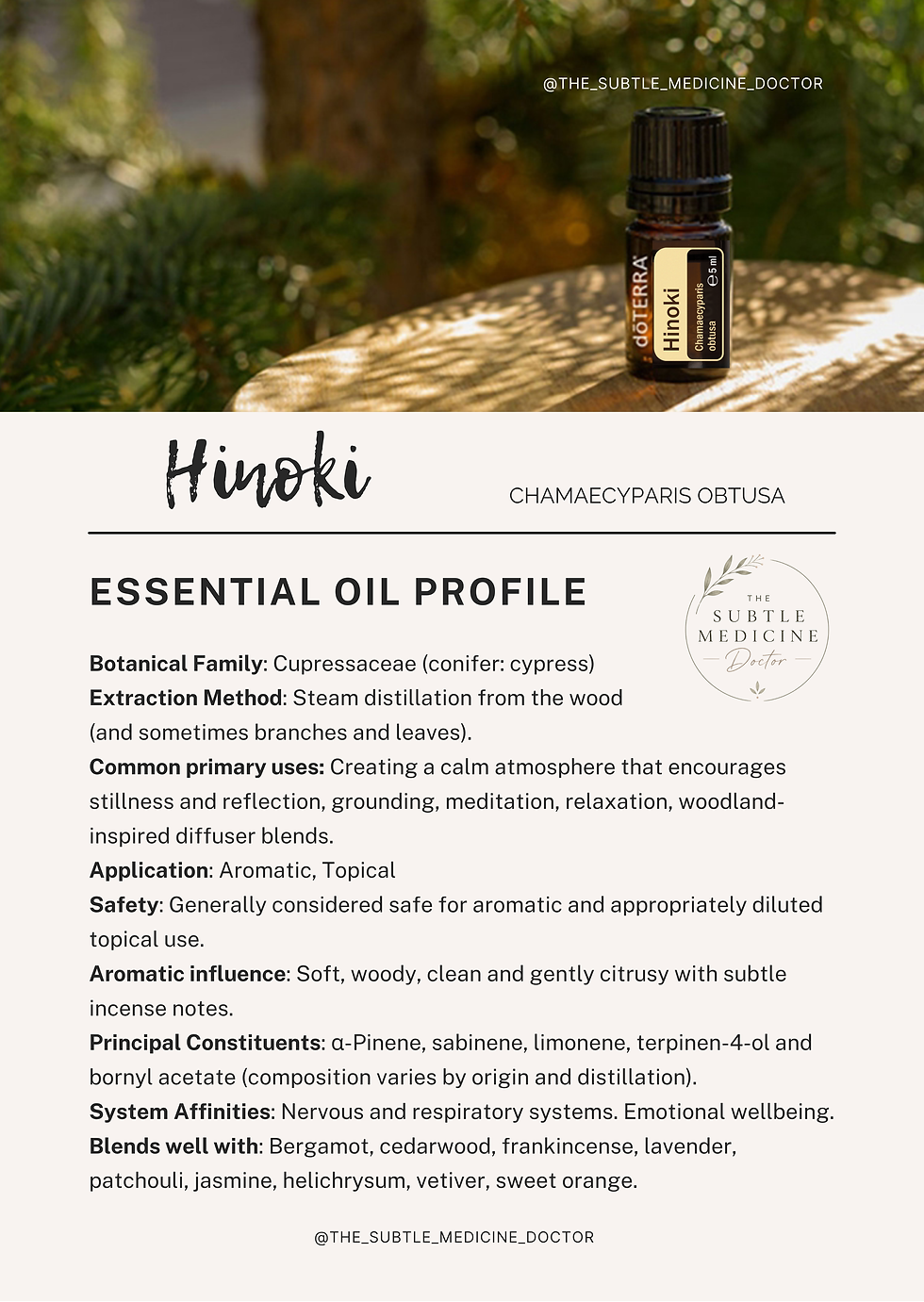
Where Does the Oil Come From?
The essential oil is steam distilled from the wood, and sometimes from the branches and leaves, depending on the producer.
Unlike oils that rely on delicate flowers or fresh citrus peel, Hinoki comes from the heartwood itself. The fragrance carries something of the tree's age and patience.
Because Hinoki is one of Japan's most treasured timbers, the essential oil is often produced from wood left behind by sustainable forestry and timber production. Rather than harvesting ancient trees solely for essential oil, many producers make use of fallen trees, responsibly culled trees or timber that would otherwise go to waste. It feels wonderfully fitting that an oil so associated with peace also reflects a philosophy of respecting every part of a precious resource.
It takes decades for a Hinoki tree to mature fully, which perhaps explains why the aroma feels so grounded.
What Does Hinoki Essential Oil Smell Like?
This is one of those oils that's surprisingly difficult to describe.
It is woody, certainly, but also spacious. A sense of soft lemony freshness woven through warm timber. There are subtle hints of incense, gentle spice and clean forest air.
Some people describe a faint sweetness that becomes more noticeable as the oil settles.
If you've ever walked into a beautifully crafted wooden Japanese bathhouse or stood quietly among ancient conifers after rainfall, you'll recognise something of that atmosphere here.
The Chemistry Behind Hinoki Essential Oil
Hinoki's fragrance is supported by an interesting blend of naturally occurring compounds.
Its chemistry commonly includes:
α-Pinene
Sabinene
Limonene
Terpinen-4-ol
δ-Cadinene
Elemol
Together these constituents help explain why the oil often feels simultaneously fresh, grounding and gently uplifting.
Like many conifer oils, Hinoki contains monoterpenes that contribute to its bright forest aroma, while its sesquiterpenes provide the deeper, longer-lasting woody character.
As with all essential oils, the precise chemistry varies depending on where the trees are grown, the part of the tree distilled and the distillation process itself.
Hinoki Essential Oil and Forest Bathing

One of the most fascinating areas of research surrounding Hinoki relates to the Japanese practice of Shinrin-yoku, often translated as forest bathing.
Forest bathing isn't hiking for fitness, or about reaching a destination or summit. It simply means spending time immersed in woodland, allowing yourself to experience the sights, sounds and scents of the forest.
Researchers first began investigating why people consistently reported feeling calmer after time among trees. One hypothesis centres on compounds called phytoncides - volatile aromatic molecules released naturally by trees, many of which are chemically similar to the constituents found in conifer essential oils.
Studies have shown that spending time in forests may help reduce stress hormones, lower blood pressure, improve mood and even influence aspects of immune function.
Scientists are still exploring exactly how much of these benefits come from the aromatic compounds themselves versus the wider experience of being outdoors, moving gently, breathing deeply and stepping away from modern distractions. What seems increasingly clear is that forests affect us in measurable ways.
No essential oil can replace time outside among living trees, but Hinoki captures something of that woodland atmosphere. When a walk beneath towering cypress trees isn't possible, its aroma offers a gentle reminder of the stillness waiting for us beyond our busy lives.
In Japan, soaking in a traditional Hinoki bath is an experience in itself. As warm water gently heats the fragrant timber, the room fills with its unmistakable woodland aroma. For centuries this has been part of everyday wellbeing rather than an occasional luxury - a reminder that our relationship with plants can be woven firmly into daily life.
A Beautiful Japanese Word

The Japanese language contains many beautiful words, one of which is: komorebi. It describes the sunlight filtering through the leaves of trees.
There isn't a perfect English translation because it isn't simply about light. It captures a feeling as much as a scene. Whenever I smell Hinoki, I like to think of the feeling of komorbi.
Its aroma isn't loud or dramatic. It feels like dappled sunlight in an ancient forest, quiet enough that you almost have to stop what you're doing to notice it.
What Does the Evidence Tell Us About Hinoki Essential Oil?
Although Hinoki hasn't been studied as extensively as lavender or tea tree, interest in this remarkable tree continues to grow.
Laboratory studies have explored its antimicrobial activity against a range of microorganisms. Other research has investigated its influence on relaxation, mood and physiological markers of stress, with several small studies suggesting that inhaling Hinoki aroma may encourage feelings of calm and reduce some measurable indicators of stress.
As always, it's worth remembering that much of this research is still in its early stages. Many studies involve relatively small numbers of participants or laboratory models rather than everyday clinical use.
While the evidence is encouraging, it's still evolving. Much of what people love about Hinoki comes not from large clinical trials but from centuries of human experience. Sometimes tradition and science meet beautifully; other times science is only just beginning to catch up with what people have quietly known all along.
Emotional & Spiritual Correspondences of Hinoki Essential Oil
While scientific research helps us understand the chemistry of essential oils, many people also value the symbolic and emotional qualities that have been associated with plants for generations. These traditions aren't something science can easily measure, but they have shaped the way many aromatherapists and herbalists work with plants for centuries.
In some traditions of emotional aromatherapy, Hinoki is known as the Oil of Wise Words. It embodies ancient wisdom and harmony. Its tall, straight growth has become a symbol of integrity and purpose, an invitation to stay rooted in our values while communicating with clarity, honesty and compassion.
I like to think of Hinoki as an oil for those moments when we don't quite know what to say. For those uncertain of how to respond, or hesitant to speak for fear of hurting someone they care about, Hinoki offers a quiet reminder that gentle words can still be truthful, and honesty can still be kind.
Rather than reacting from fear or emotion, Hinoki encourages us to pause, gather our thoughts and respond with wisdom. Like the tree itself, it reminds us to grow tall and straight, to stand confidently in who we are while remaining calm, compassionate and connected to our purpose.
Whether or not you connect with these traditional correspondences, there's something undeniably centring about breathing in the scent of an ancient forest before an important conversation.
Living with Hinoki Essential Oil

This is where I think Hinoki truly shines. Rather than reaching for it because you have a particular symptom, I find it becomes an oil that shapes the atmosphere around you.
Diffuse it while reading.
Add a drop to a tissue beside your pillow.
Blend it into an evening massage oil.
Use it while journalling or meditating.
Or simply inhale it before opening your laptop on a busy morning.
Sometimes we simply need reminding what calm feels like and I think Hinoki is that antidote to modern life. It's an oil that asks very little of us. You don't need to know its chemistry or memorise its therapeutic properties, simply opening the bottle and breathing slowly is enough.
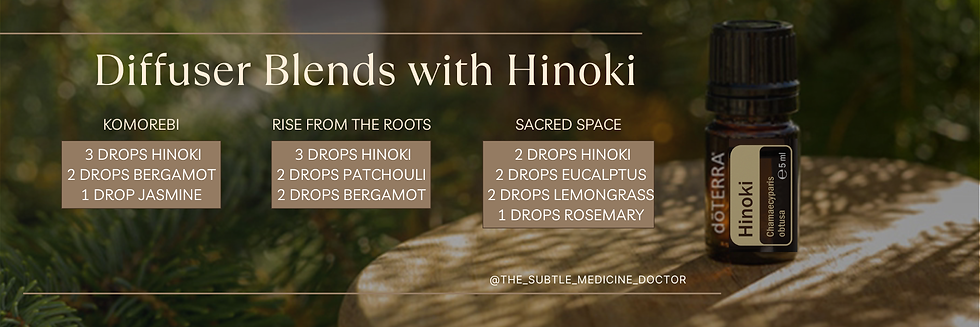
Blending Ideas for Hinoki Essential Oil
Hinoki blends beautifully with other quiet, grounding oils.
Try pairing it with:
Frankincense for reflection and stillness.
Cedarwood for a deeper woodland character.
Lavender for peaceful evenings.
Bergamot to brighten the woods with gentle citrus.
Vetiver when you want something deeply grounding.
Sweet Orange or mandarin for a softer, more welcoming blend.
Helichrysum for gentle warmth and restoration.
Jasmine (used sparingly) for soft floral elegance.
Hinoki Essential Oil Safety
Hinoki is generally regarded as well tolerated when appropriately diluted for topical use.
As with all essential oils:
Dilute before applying to the skin.
Perform a patch test when using a new oil.
Avoid contact with the eyes and mucous membranes.
Keep out of reach of young children.
If you are pregnant, breastfeeding or living with a medical condition, seek advice from an appropriately qualified healthcare professional before therapeutic use.
Hidden Gem
If I had to describe Hinoki in one sentence, I'd say this:
It smells like the pause you take before speaking.
We often think of essential oils as concentrated medicine. Hinoki reminds me that they can also be concentrated places.
Open the bottle and, for a moment, you're standing in a quiet Japanese forest, surrounded by towering trees that have witnessed centuries pass beneath their branches.
It doesnt shout, it simply offers the scent of old forests, patient trees and the gentle reminder that sometimes slowing down is exactly what we need.
This article was written by Lucy Connor, an aromatherapist with a love of plants, essential oils and the changing seasons. My aim is to share reliable, evidence-informed information while celebrating the remarkable stories that plants have been telling for centuries. I hope these articles encourage you not only to use essential oils well, but to notice the living world from which they come.


I love the way this is written. It is about engaging with the oil in an open manner and just waiting to see what arises for you. Hinoki oil is unlike any other oil with a gentle aroma that calms and reassures. It is one of my favourites.