
Citronella Essential Oil: More Than Just an Insect Repellent

Updated: Jun 21

Mention citronella and most people immediately think of mosquitoes.
Garden candles. Camping trips. Summer evenings. Bottles of insect repellent hastily packed into holiday suitcases.
It is one of the most recognisable essential oils in the world and yet, perhaps because of that familiarity, very few people ever stop to look more closely at it.
This month's Oil Club episode challenged me to do exactly that.
The deeper I looked into citronella's botany, chemistry and history, the more I realised that we have collectively placed this remarkable oil into a rather small box. Somewhere along the way it became "the mosquito oil" and little else, but the truth is far more interesting.
Citronella is not a citrus oil. It isn't really a floral oil. It isn't quite an herb oil either. Instead, it occupies a fascinating middle ground, combining fresh lemony brightness with surprisingly elegant floral notes and a rich history of human use.
Before we dive deeper, you can watch the full Oil Club episode here:
A Grass That Pretends To Be Citrus

One of things people might find most surprising about citronella is that it doesn't come from a citrus fruit at all.
Citronella essential oil is distilled from aromatic grasses belonging to the Cymbopogon genus. Making it much more closely related to lemongrass, palmarosa and vetiver than it is to lemons, limes or oranges. Which often comes as a surprise because most people describe citronella as smelling distinctly lemony.
The first time you inhale it, your brain immediately begins searching for a citrus connection. Yet if you spend a little longer with the aroma, something else emerges. Unlike lemon essential oil, citronella has a distinct green quality. There is a grassy freshness beneath the bright top notes that hints at the plant's true identity. Once you know it comes from a grass, it becomes impossible not to notice.
Why Does Citronella Smell Like Lemon?
This question touches on one of the things I find most fascinating about aromatherapy. Plants that are completely unrelated can sometimes smell remarkably similar.
Citronella and lemon are a perfect example.
Although they belong to entirely different botanical families, they share certain aromatic compounds that create familiar citrus-like impressions. The plant has evolved these compounds for its own purposes, rather than for our benefit. Long before we bottled citronella and sold it around the world, the plant was using these aromatic molecules as part of its own survival strategy.
The essential oil contains significant amounts of citronellal, one of the key constituents responsible for its fresh, lemon-like aroma. It also contains smaller amounts of limonene, a compound found throughout the citrus family.
The result is an aroma that feels familiar while coming from an entirely different branch of the plant kingdom. Nature, it seems, often arrives at similar solutions through very different routes.
The Rose Hidden Inside Citronella
This is the part of citronella's story that I suspect surprises people most.
When aromatherapists study the chemistry of citronella, they often notice names that may seem strangely out of place.
Geraniol.
Citronellol.
These compounds are also found in some of our best-loved floral oils, including rose, geranium and palmarosa.
Suddenly citronella becomes much more than a simple insect-repelling oil. Beneath the fresh, green, lemony opening lies a softer floral character that many people overlook entirely.
The next time you smell a quality citronella essential oil, try approaching it differently. Rather than asking yourself whether it smells lemony, ask yourself whether you can detect anything floral hiding underneath - can you detect hints of rose or geranium?
You may be surprised by what you find. This floral dimension helps explain why citronella found its way into perfumes, soaps and personal care products long before most of us encountered it in garden candles. Perfumers recognised that there was much more going on than simple freshness.
Why The Plant Produces These Compounds
One of the questions I return to again and again when studying essential oils is this: Why is the plant making these chemicals in the first place?
The plant isn't producing essential oil for our benefit.
It isn't trying to help us relax.
It isn't trying to freshen our homes.
It certainly isn't trying to sell mosquito repellents.
The aromatic compounds found within citronella evolved because they gave the plant some sort of advantage. Researchers believe these compounds may help protect the plant from insects, grazing animals, microbial threats and environmental pressures. The exact reasons vary between species and compounds, but the principle remains the same: the essential oil is part of the plant's survival toolkit.
When we use citronella in our homes, we are essentially borrowing a sophisticated chemical defence system that nature spent millions of years developing. I think that perspective makes aromatherapy infinitely more interesting.
Beyond Mosquitoes: Living With Citronella
Of course, citronella's reputation for helping create a more comfortable outdoor environment is well deserved.
However, if that is the only way you use it, you are missing out on some of its most enjoyable qualities.
Freshening Indoor Spaces
One of my favourite ways to use citronella is in home cleaning and freshening blends. The aroma feels genuinely clean, not artificially clean with the synthetic freshness of many commercial products. Instead, it reminds me of open windows, fresh air and sunlight streaming into a room. A few drops added to a natural surface spray can instantly transform the atmosphere of a space.
Diffusion
Citronella is also far more enjoyable in the diffuser than many people expect.
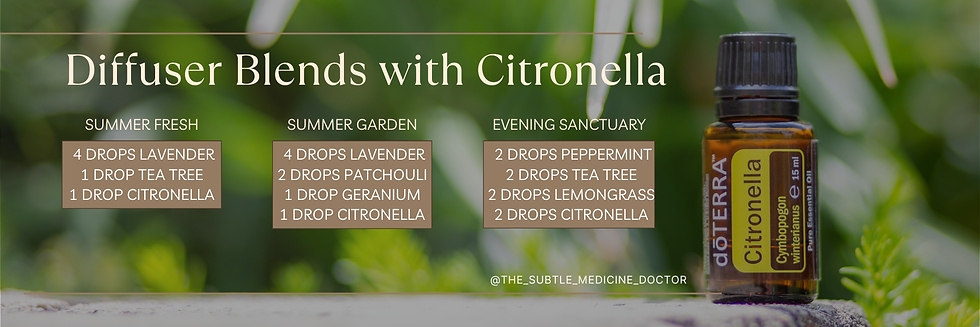
I particularly enjoy blending it with:
Bergamot
Lime
Wild orange
Lavender
Geranium
Cedarwood
The result is uplifting, bright and surprisingly sophisticated. Rather than dominating a blend, citronella often acts as a bridge between citrus and floral oils, helping them work together harmoniously.
Body and Scalp Care
Citronella has a long history of appearing in shampoos, soaps and body care products. When properly diluted, it can be incorporated into scalp oils, hair treatments and body care blends where its fresh aroma contributes both character and vitality. It works particularly well alongside rosemary, lavender and cedarwood.
Mosquito Repellant Spray
You could always choose to incorporate the "Evening Sanctuary" diffuser blend into a mosquito-repelling spray. Simply add the essential oils and 30ml or so of high-proof alcohol to a spray bottle and top with distilled water. Shake well before use and reapply hourly.
The Curious Case Of The Garden Centre Citronella Plant

There is one final citronella mystery worth mentioning. If you've ever purchased a "citronella plant" from a garden centre, there is a high chance it wasn't actually citronella.
Many plants marketed as "citronella plants" are in fact lemon-scented geraniums.
They smell similar and are sold for similar purposes, but botanically they are entirely different.
True citronella belongs to the grass family. The so-called citronella plant often belongs to the geranium family. This confusion arises because both plants contain aromatic compounds that create fresh lemony impressions.
It's a wonderful reminder that smell alone doesn't always tell the whole story.
Plants can smell remarkably alike while being only distantly related.
Why I Think Citronella Is Underrated
Some oils become famous because they smell beautiful, others because they are associated with a particular therapeutic application.
Citronella became famous because it helped solve a practical problem and was indeed the most widely used insect repellent prior to the introduction of prior to the invention of N,N diethyl 3-methylbenzamide better known as DEET in 1946.
Unfortunately, that practical success has overshadowed everything else. Yet behind the familiar reputation lies a fascinating aromatic plant with surprising chemistry, a rich history and far greater versatility than most people realise.
The more time I spend with citronella, the less I think of it as a mosquito oil.
Instead, I think of it as an oil of freshness. A tropical grass whose chemistry helped it survive. An aromatic traveller that moved across continents through trade. An oil that reminds us how much complexity can hide beneath something familiar.
And perhaps that is citronella's greatest lesson: sometimes the oils we think we know best are the ones most worth revisiting.



Wow 🤩
Beautifully written piece Dr Lucy, I will buy your book tomorrow
“ the Subtle Medicine Doctor 💚”Hamida 🙏🏻