
Elderberry: How to Harvest, Prepare & Use This Late-Summer Hedgerow Medicine

Updated: Aug 13

There is something rather wonderful about returning to the same plant through the seasons.
Back in early summer, we met the elder tree in flower.
Its creamy-white blossoms filled the hedgerows, we explored some of the extraordinary folklore that has surrounded this tree for centuries, and looked at the long history of elderflower as both food and traditional medicine.
But elder wasn't finished with us.
Over the weeks that followed, those frothy flower heads quietly changed. The petals disappeared, tiny green fruits formed and gradually, almost imperceptibly, they began to darken.
By late summer, the same branches that held elderflowers only a few months ago are beginning to bow beneath clusters of glossy purple-black berries.
This is elder's second harvest.
And in many ways, it gives us an entirely different medicine.
Elderberry has a long history of use in European herbal medicine, particularly through the colder months, and today it is probably best known for the deep purple syrups that begin appearing in home apothecaries as autumn approaches.
But learning to work with elderberry is about far more than knowing how to make a syrup.
It's knowing when the fruit is genuinely ripe. How to harvest without stripping the hedgerow. Why preparation matters. What to do when the berries are ready before you are. And, perhaps most importantly, how to hold centuries of traditional use alongside what modern research can - and can't - actually tell us.
That is what we're going to explore here.
If this is your first encounter with elder, I would begin with my Complete Guide to Elderflower: Foraging, Folklore, Medicine & Seasonal Recipes, where we look much more closely at the elder tree itself, its history and folklore, botanical identification, lookalikes and responsible harvesting.
For now, though, let's return to the hedgerow.
The elderberries are ready.
From Elderflower to Elderberry
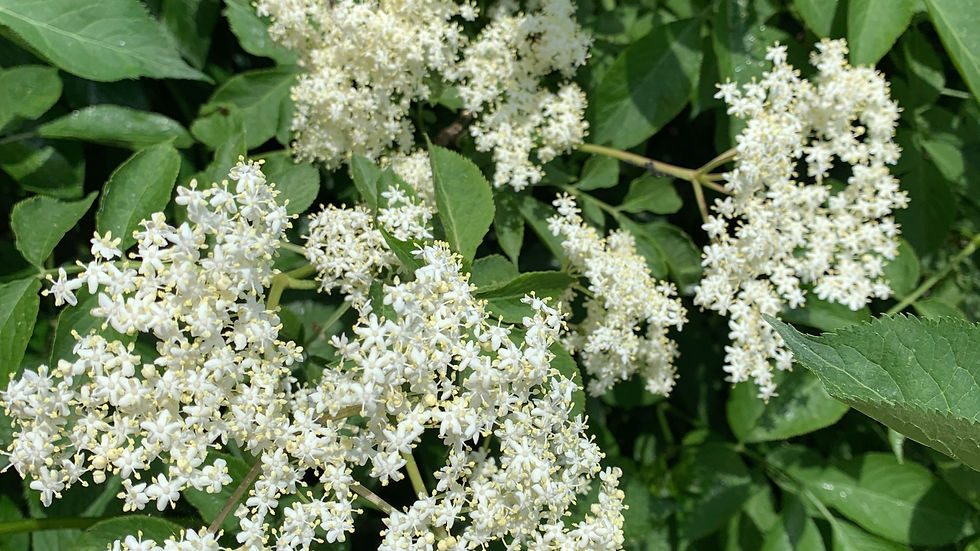
One of the loveliest ways to really learn a wild plant is to return to it throughout the year.
Perhaps you noticed your local elder earlier in the summer, when its broad heads of creamy-white flowers seemed to appear everywhere. Once those flowers are pollinated, their petals fall and tiny green fruits begin to form.
Over the following weeks, the berries become larger and darker, passing through green and reddish stages before eventually reaching the glossy purple-black we're looking for.
The stems supporting them often deepen to pink or reddish-purple too, while the once relatively upright flower heads begin to hang downwards under the weight of the fruit.
And suddenly the plant you knew as elderflower looks completely different.
There is something important in this, I think. So much modern plant knowledge is learned from isolated photographs: Here is an elderflower. Here is an elderberry. And here is what you can make with it.
But knowing a plant is different.
It means recognising what it looks like through different seasons. Knowing where it grows. Remembering where you saw the flowers. Watching those flowers become fruit.
Over time, the elder stops being something you have identified from a field guide and becomes something familiar. And I believe that kind of familiarity is at the heart of what we're trying to build with our home apothecaries.
Why Elderberry Is Worth Knowing
Before we get into identification and harvesting, I think it's worth answering a more fundamental question: why bother gathering elderberries at all?
For me, their value begins with just how ordinary they are.
Elder grows abundantly through much of Britain, tucked into hedgerows, field edges, parks and forgotten corners of our towns and villages. By late summer, many of these trees are carrying great clusters of dark fruit - a seasonal food and traditional medicine growing quite literally on our doorsteps.
And these aren't simply berries we've retrospectively decided to call medicinal. Elderberry has a long history of traditional use, particularly through the colder months and around respiratory illness. The berries are naturally rich in deeply coloured plant compounds called anthocyanins, alongside other polyphenols and nutrients, and modern research has begun to investigate some of those traditional uses too. As we'll explore later, the clinical evidence isn't strong enough for some of the claims now made about elderberry online, but there are promising findings around the duration and severity of some viral respiratory symptoms.
Perhaps more importantly, elderberry gives us something that no bottle of capsules really can: a relationship with the medicine itself.
We can learn where elder grows. Watch the flowers appear in early summer and the berries slowly replace them. Recognise when the fruit is genuinely ripe, gather a little when there is plenty, and preserve it as syrup, dried berries, a decoction or simply as food for the colder months ahead.
That feels significant to me because a home apothecary doesn't have to begin with buying more things. Sometimes it begins with learning that something useful has been growing at the end of your road all along.
And elderberry is a particularly beautiful place to start.
Elderberry at a Glance
Botanical name: Sambucus nigra
Common names: Elder, common elder, black elder, elderberry
Plant family: Adoxaceae
Part used here: Fully ripe berries
Harvest: Usually late summer into autumn in Britain, although timing varies considerably with location, weather and growing conditions
Traditional association: Colds, influenza-like illnesses and winter respiratory complaints
Important preparation note: Elderberries should be properly prepared before eating. Raw or unripe fruit, along with the leaves, stems and other parts of the plant, contain cyanide-producing compounds that can cause nausea, vomiting and diarrhoea. The berries should be cooked before consumption.
A Quick Elder Identification Refresher
Before we start looking at whether the berries are ripe, let's make sure we're looking at the right plant.
If you're completely new to elder, please don't identify it from its berries alone. Safe foraging means looking at the whole plant and building up a picture from several identifying features rather than relying on just one.
Common elder, Sambucus nigra, usually grows as a shrub or small tree. Its leaves are pinnate, typically made up of five or seven toothed leaflets arranged in opposite pairs, with a single leaflet at the end. Older branches and trunks develop distinctive pale grey-brown bark that becomes increasingly corky and deeply furrowed with age.
If you met this same tree earlier in the summer, you may remember its broad, flat-topped clusters of tiny creamy-white flowers. Those flowers gradually give way to small berries, which change from green through reddish shades before eventually ripening to a deep purple-black. The branching stalks that hold them often deepen to reddish-pink or purple too.
And this is one of the reasons I love returning to the same plants throughout the year.
If you watched an elder come into flower, noticed where it was growing and then returned over the following weeks to see those flowers gradually become fruit, you're no longer trying to identify a handful of dark berries from a photograph - you're beginning to recognise the plant itself.
For much more detail on identifying elder, including its flowers, leaves, bark and lookalikes, head back to my Complete Guide to Elderflower: Foraging, Folklore, Medicine & Seasonal Recipes.
And the usual rule always applies:
If you're not completely confident that you have correctly identified a wild plant, don't consume it.
When Are Elderberries Ready to Pick?

Perhaps one of the most useful things foraging teaches us is that nature doesn't work from our calendars.
Elderberries are generally a late-summer to autumn harvest in Britain. In an average year, we might expect to begin seeing ripe fruit from August onwards, although berries can ripen considerably earlier or later depending on where you live and the conditions that year.
These dates are only a guide however, as temperature, rainfall, aspect, geography and the conditions experienced by an individual plant all influence how quickly its fruit develops.
And this year has been a particularly good reminder of that.
Here in the UK, after such a hot, dry summer, many of the elderberries around me are ripening earlier than I might normally expect. Some of the clusters are smaller and the berries less plump too, which isn't particularly surprising after so little rainfall.
This an observation from the plants growing around me rather than a rule that will apply to every elder tree in Britain, but it illustrates exactly why I think we should learn to watch the plant rather than wait for a particular date in the diary.
If your local elderberries are already dark, soft and ripe in August, don't ignore them because you thought elderberry season belonged to September. Equally, if yours are still green, there is no need to hurry them simply because somebody else's harvest has already begun. The plant itself is giving you the best information.
One final thing to bear in mind: once the fruit is ripe, particularly during a hot or dry year, I wouldn't necessarily assume it will remain beautifully plump on the tree for weeks.
So if the berries are ready but you aren't quite ready to make anything with them yet, don't fret - harvest what you need and pop them in the freezer until you are.
Harvest when the plant is ready. Make when you're ready.
Those two things don't always have to happen on the same day. And in this way, we can make our home apothecary work with the season rather than asking the season to wait for us.
How to Tell When Elderberries Are Ripe

Rather than relying on the date, do your best to learn what ripe fruit actually looks and feels like.
A ripe elderberry cluster is quite distinctive.
Look for berries that are:
deep purple-black rather than green or red
soft to the touch rather than firm and hard
glossy and juicy-looking
held on branching stems that often deepen to reddish-pink or purple
hanging downwards in heavy clusters
Individual clusters don't always ripen perfectly evenly. You may find the occasional green, red or shrivelled berry amongst otherwise beautifully ripe fruit. These can simply be removed when you process your harvest.
If most of the cluster is still green or reddish, leave it on the tree, come back in a few days and look again. That simple act of returning and noticing what has changed is part of learning the plant.
How to Harvest Elderberries Responsibly
A heavily laden elder can look extraordinarily generous, but the berries aren't only ours.
They are an important late-summer food source for birds and other wildlife, so there is never any need to strip a tree simply because you've found a particularly good crop.
I prefer to take a few fully ripe clusters from different areas of the tree, leaving plenty behind. If a tree is only carrying a small amount of fruit, I'll simply leave it alone and look elsewhere.
Choose clusters that are predominantly ripe and healthy, and leave behind anything that is still mostly green, mouldy, badly shrivelled or damaged.
A pair of small scissors or secateurs makes harvesting easy: simply snip the whole ripe cluster where its main stem joins the branch rather than trying to pick individual berries from the tree. We'll remove the berries from those smaller stems once we get home.
As with any wild harvest, think about where the plant is growing too. I avoid gathering from busy roadsides, sprayed land or anywhere else where pollution or contamination might be a concern.
It's a good idea to take a shallow basket, bowl or container with you rather than stuffing the clusters into a bag. Ripe elderberries are surprisingly delicate and can squash very easily - and that beautiful purple juice is remarkably good at finding its way onto clothes and fabric!
The aim isn't to gather as much as we possibly can but to take what we'll genuinely use, leaving plenty for everything else that relies on the tree.
And remember, you can always return.
How to Remove Elderberries from Their Stalks

Once you've brought your berries home, the first job is separating hundreds of tiny fruits from their stems.
You can, technically, pick them off one at a time, but I don't recommend discovering just how long this takes.
Instead, use a fork.
Hold the top of the cluster over a large bowl and gently draw the tines of a fork through the smaller stems. If the berries are beautifully ripe, they should tumble away quite easily.
Once you've worked your way through the clusters, have a quick sort through and remove any:
remaining pieces of stalk
leaves
green or underripe berries
shrivelled fruit
damaged or mouldy berries
Or freeze the clusters first
This is one of my favourite little elderberry tricks. If you don't have time to deal with your harvest straight away, pop the whole clusters into the freezer. Once frozen, the berries often become much easier to separate from their stems - and it saves you having to process everything the moment you walk through the door.
You can then de-stem and sort the berries when you have a little more time, returning them to the freezer if you're saving them for another day.
This is a wonderfully simple way of taking the pressure off a seasonal harvest.
As we've already established: Harvest when the plant is ready. Make when you're ready.
Can You Eat Elderberries Raw?
This is one of the most important things to understand before working with elderberries.
I don't recommend eating them raw.
Raw and unripe elderberries, together with the stems, leaves and other vegetative parts of Sambucus, contain cyanogenic glycosides. These are naturally occurring plant compounds that can release cyanide and may cause symptoms including nausea, vomiting and diarrhoea if sufficient amounts are consumed.
Cooking is therefore an important part of preparing elderberries safely.
When processing your harvest, choose fully ripe purple-black fruit, remove the stems carefully, discard green and underripe berries and remove any leaves or other plant material before cooking the berries.
I wouldn't add raw elderberries to smoothies, cold-pressed juices or other uncooked preparations.
And I think there is a particularly useful lesson in herbalism here, because knowing that a plant has beneficial properties is only half the knowledge. We also need to know which part of the plant we're using, when it should be harvested and how it needs to be prepared. This is what turns plant enthusiasm into practical botanical knowledge.
Elderberry in Traditional Herbal Medicine
Elder has occupied an extraordinary place in European folk medicine for centuries.
In my Complete Guide to Elderflower, we explored the traditional use of the flowers, particularly in hot infusions around feverish colds and upper-respiratory complaints. The berries have their own history and became particularly associated with respiratory infections and the colder months, a tradition that continues today in the form of syrups, extracts, lozenges and numerous commercial preparations.
It is common to see elderberry described as an “immune booster” or “powerful natural antiviral”, and there are interesting reasons why this reputation developed. There is also a considerable gap between some of those claims and what human clinical research has actually established.
So let's look at the evidence rather than simply repeating the folklore.
Elderberry, Colds and Flu: What Does the Research Actually Say?

This is where elderberry becomes particularly interesting.
Unlike many traditional remedies that have barely been investigated in humans, several small clinical trials have studied elderberry preparations during upper-respiratory infections and influenza-like illness, and some have produced promising findings.
One frequently cited randomised, double-blind, placebo-controlled trial involving 60 people experiencing influenza-like symptoms found that participants receiving a standardised elderberry syrup reported symptom improvement several days earlier, on average, than those receiving placebo.
That sounds impressive, but there are some important qualifications. It was a small study, it investigated a particular commercial preparation rather than homemade elderberry syrup, and the authors themselves concluded that larger studies were needed to confirm the findings.
Later systematic reviews have arrived at much the same place. There is promising evidence that elderberry may reduce the duration or severity of some viral upper-respiratory symptoms, but the number and quality of studies are currently too limited for firm conclusions. A 2021 systematic review similarly concluded that elderberry may have a role in respiratory illness, while describing the evidence around both its benefits and harms as uncertain.
I think that distinction matters enormously. Promising isn't the same as proven, and saying that doesn't diminish elderberry or the generations of traditional knowledge surrounding it. It simply means being honest about where the science is up to, while remaining open to what future research may tell us.
Elderberry as Food as Well as Medicine
One of the things I particularly love about elderberry is that it sits so comfortably between kitchen and apothecary.
Once properly cooked, these sharp little berries can become syrups, jams and jellies, chutneys, compotes, cooked cordials, sauces, pies, crumbles and all sorts of hedgerow preserves. And perhaps this is worth remembering when we think about what a home apothecary actually is.
Historically, useful plants didn't necessarily live in little brown bottles with medicinal labels attached. They moved between food and medicine. A glut of fruit was preserved because it was abundant now and might be useful later. A warming drink could also be a remedy, while a jar in the pantry could offer both nourishment and a way of caring for somebody who wasn't feeling well.
I think we've sometimes made the idea of “using herbs medicinally” rather more complicated than it needs to be.
How to Preserve Elderberries

If you're lucky enough to find a good elderberry harvest, there is no need to turn it all into one preparation. There are several lovely ways to preserve it, depending on how you think you might want to use the berries later.
Freeze them
Probably the simplest method of all, and certainly the one I'd choose if the berries are ready before you are.
You can destem and sort the berries before freezing them in labelled freezer-safe containers, or briefly freeze the whole clusters first and destem them afterwards. Either way, it allows you to gather the fruit while it's beautifully ripe without having to decide immediately what you're going to make with it.
Dry them
Elderberries can also be dried for later use. Because berries contain considerably more moisture than leaves or flowers, they need to be thoroughly dried before going anywhere near an airtight storage jar, as any residual moisture creates an opportunity for mould.
Once completely dried, they can be stored somewhere cool, dark and dry and used later in preparations that involve proper cooking or simmering.
Make a syrup or decoction
Probably the preparation most associated with elderberry today is syrup, where the berries are cooked, strained and combined with a sweetening ingredient to create that familiar deep-purple winter preparation.
Dried berries also lend themselves well to a decoction — a useful herbal technique in which denser plant material is gently simmered in water rather than simply infused as we might a delicate flower or leaf.
Preserve them as food
And, of course, elderberries don't have to become “medicine” at all. They make beautiful chutneys, jams, compotes and other hedgerow preserves, particularly alongside autumn fruits such as apple and blackberry.
We'll explore some of these properly in the companion recipe guide rather than trying to squeeze them all in here.
What Can You Make with Elderberries?

Just as I did during elderflower season, I'm keeping the practical recipes separate from this botanical guide. My companion Favourite Elderberry Recipes & Remedies collection will bring together the preparations I think are genuinely worth making, with the full quantities, methods and storage guidance in one place.
We'll explore a traditional elderberry, ginger and spice syrup, a simple elderberry decoction, some lovely ways of combining elderberry with other late-summer hedgerow fruits, and a few different ways of preserving the harvest for the colder months ahead.
→ My Favourite Elderberry Recipes & Remedies [link coming soon]
And if it's the flowers you're looking for rather than the berries, my Favourite Elderflower Recipes & Remedies includes elderflower oxymel, syrup, tea and several other seasonal preparations.
Elderflower and Elderberry: Same Tree, Different Medicine
This may be my favourite lesson from following elder through the year.
In early summer, we gathered the flowers. Now we're gathering the fruit. Same plant, different season, different plant part - and not necessarily the same medicine.
Elderflower has its own constituent profile, traditional preparations and therapeutic associations, while elderberry has another. And I think understanding that helps us move away from simply asking, “What is elder good for?” and towards much more useful questions.
Which part of the plant are we using? When was it harvested? Is it fresh or dried? How was it prepared? What was it traditionally used for, and what does modern evidence actually support?
Those are the kinds of questions that take us beyond collecting lists of herbal “benefits” and towards genuinely understanding medicinal plants.
The Elder's Second Harvest
My favourite thing about gathering elderberries is the simple act of returning to a tree you already know.
Only a few months ago, you may have stood beneath it while it was covered in creamy flowers. Perhaps you gathered some, perhaps you made something with them, or perhaps you simply noticed them. Then summer moved on, the flowers disappeared and tiny berries appeared in their place.
Eventually, you walk past that same tree and notice its branches hanging down beneath dark fruit.
The plant has changed, and because you've been paying attention, you notice.
That, for me, is the real skill underneath all these recipes. Knowing when something flowers and when it fruits, what ripe looks like, what to leave behind and how to preserve a little of what is abundant now for the season that comes next.
These were once extraordinarily ordinary skills, and I think there is something truly powerful about learning them again. Not because we need to recreate the past, or because every hedgerow needs to become a medicine cabinet, but because knowing the plants around us changes the way we experience the landscape.
The anonymous hedge becomes elder. The elderflower becomes elderberry. August becomes not simply another month, but the time when the berries begin to darken.
And it feels like that is really what our Late Summer Apothecary is about: gathering what is here, preserving what we can and quietly preparing for what comes next.
Further Reading: Your Elderberry Questions Answered
Did Elderberry Really Perform as Well as Tamiflu?
You may have come across the claim that elderberry has been shown to work as well as, or even outperform, the antiviral medicine Tamiflu (oseltamivir). Interestingly, there is a real clinical trial behind this claim, although the full story is a little more nuanced than the headline suggests.
In 2015, researchers conducted a randomised clinical trial involving 473 people with early influenza symptoms, directly comparing oseltamivir with a herbal hot drink. The herbal preparation was found to be non-inferior to oseltamivir, meaning that recovery was sufficiently similar for it to meet the study's criteria for performing no worse than the antiviral treatment.
However, there is an important detail that often gets lost when this study is shared: the herbal preparation wasn't elderberry alone. It contained echinacea together with elderberry, which means we can't separate out the contribution elderberry made to the result.
There have been separate clinical trials looking specifically at elderberry preparations, including a small placebo-controlled study in which people taking a standardised elderberry syrup reported improvement in their influenza-like symptoms several days earlier than those taking placebo. But elderberry on its own hasn't been directly compared with Tamiflu.
So, there really was a side-by-side trial in which a preparation containing elderberry performed comparably to oseltamivir - but describing it simply as “elderberry versus Tamiflu” misses the rather important presence of echinacea.
Does Elderberry “Boost” the Immune System?
I'm increasingly cautious about the phrase immune boosting in general.
Our immune system isn't a simple dial that we always want to turn higher. It is an extraordinarily complex network of cells, tissues and signalling molecules whose job is not merely to react strongly, but to respond appropriately.
Elderberry contains a range of biologically active compounds, and laboratory research has investigated possible antiviral, anti-inflammatory and immune-modulating effects of elderberry extracts. But describing a spoonful of elderberry syrup as a powerful “immune booster” simplifies something far more complex, particularly when much of the research exploring these mechanisms has taken place in laboratory settings rather than in people.
Interestingly, there has also been concern in recent years about the opposite possibility - that elderberry might somehow overstimulate the immune system. This was particularly discussed during the Covid-19 pandemic, when claims began circulating that elderberry could contribute to the excessive inflammatory response sometimes referred to as a “cytokine storm”.
When researchers looked specifically at this question in a 2021 systematic review, they found no evidence that elderberry causes this kind of dangerous immune-system overactivation. That doesn't mean we understand everything about the way elderberry interacts with immune signalling, but it does give us another useful example of why both enthusiastic health claims and alarming warnings deserve the same careful scrutiny.
What we have instead is a plant with a substantial traditional association with respiratory illness, some fascinating laboratory research and a small body of human clinical evidence that is encouraging, but still incomplete. For me, that's quite enough to make elderberry interesting without needing to call it an “immune booster” at all.
Can Elderberry Prevent Colds and Flu?
This distinction is particularly important because many people take elderberry syrup every day through autumn and winter specifically to prevent infection, and it has become an increasingly familiar part of the modern home apothecary.
However, the evidence for prevention is less convincing than the preliminary evidence around reducing the duration or severity of symptoms once a respiratory illness has developed. At present, there simply isn't enough good-quality human research to say that taking elderberry syrup every day will reliably stop someone catching a cold or influenza.
So whilst I wouldn't describe it as a proven preventative, that doesn't mean there isn't a place for a properly prepared elderberry syrup or other elderberry preparation in our winter apothecaries.
What Is Actually Inside an Elderberry?
Take one look at the extraordinary purple-black colour of ripe elderberries and you already have a clue to some of what makes them interesting.
That colour comes largely from anthocyanins, naturally occurring plant pigments responsible for many of the deep reds, purples and blues we see in fruits and berries. These belong to a wider family of compounds called polyphenols and are particularly interesting for their antioxidant activity. Elderberries also contain other polyphenols, alongside nutrients including vitamin C and fibre.
That beautiful purple-black colour we've already learned to recognise as a sign of ripe fruit comes from these anthocyanin pigments, giving us a rather lovely visible glimpse of the chemistry inside the berry. The exact composition varies with ripeness, growing conditions and processing, but together these compounds help explain why such tiny fruits have attracted so much scientific interest.
Elderberry Safety & Precautions
We've already looked at the importance of correct identification, choosing fully ripe berries, removing stems and leaves and properly cooking the fruit, so I won't repeat all of that here. There are, however, a few additional considerations worth bearing in mind if you're planning to use elderberry medicinally rather than simply enjoying properly prepared berries as food.
There isn't enough evidence to establish the safety of medicinal amounts of elderberry during pregnancy or breastfeeding, so this is an area where I would take additional care and seek appropriate individual advice.
Similarly, if you take regular medication, live with an ongoing medical condition or are considering using concentrated elderberry preparations therapeutically, it makes sense to check that they are appropriate for you with a suitably qualified healthcare professional.
And, as always, a home herbal preparation isn't a substitute for appropriate medical care. Significant or worsening illness, difficulty breathing, dehydration, severe or persistent fever, unusual lethargy or anything else that concerns you deserves proper assessment.
What About Elderberry for Children?
This is one area where I prefer not to give sweeping online dosing instructions. There is an important difference between a child enjoying properly cooked elderberries as part of ordinary food and giving a concentrated elderberry preparation for a therapeutic purpose. Age, size, health, medication and the preparation itself can all matter, which is why I don't think a blanket instruction such as “one teaspoon for children” is particularly helpful.
If you do want to use elderberry in this way, I think an age-appropriate commercial preparation can be a sensible option, simply because you know the concentration of the particular product you're using and can follow its specific age and dosing instructions rather than trying to calculate a dose from a homemade syrup. Products such as Sambucol Kids Liquid, for example, have children's formulations with clearly stated age ranges and directions for use.
As always, check the individual product rather than assuming all elderberry preparations are equivalent, and if your child takes medication, is under medical supervision or you have any concerns about whether elderberry is appropriate for them, speak to an appropriately qualified healthcare professional.
Continue Exploring Elder
If you'd like to continue getting to know elder through the seasons, these guides are a lovely place to go next.
If you're new to elder, I would begin here. We explore the tree in flower, including botanical identification, folklore and history, traditional elderflower medicine, responsible harvesting and the first elder harvest of the year.
A practical collection of some of my favourite ways to use and preserve elderflowers, including elderflower oxymel, syrup, tea and other simple home-apothecary preparations.
My Favourite Elderberry Recipes & Remedies
The practical companion to this guide, bringing together the elderberry preparations I think are genuinely worth making, with full recipes, methods and storage guidance.
Coming next.
References & Further Reading
For those who would like to explore the research and botanical information behind this guide in more detail, these are some of the sources used in its preparation.
National Center for Complementary and Integrative Health (NCCIH). Elderberry: Usefulness and Safety. National Institutes of Health.Useful overview of current clinical evidence and elderberry safety, including raw and unripe fruit, cyanogenic compounds, medicines, pregnancy and breastfeeding.
Woodland Trust. Elder (Sambucus nigra) – British Trees.Botanical identification, leaves, bark, flowers, fruit and seasonal development of common elder in Britain.
Zakay-Rones, Z., Thom, E., Wollan, T. & Wadstein, J. (2004). Randomized study of the efficacy and safety of oral elderberry extract in the treatment of influenza A and B virus infections. Journal of International Medical Research, 32(2), 132–140.https://doi.org/10.1177/147323000403200205
Wieland, L.S., Piechotta, V., Feinberg, T. et al. (2021). Elderberry for prevention and treatment of viral respiratory illnesses: a systematic review. BMC Complementary Medicine and Therapies, 21, 112.https://doi.org/10.1186/s12906-021-03283-5
Rauš, K., Pleschka, S., Klein, P., Schoop, R. & Fisher, P. (2015). Effect of an Echinacea-Based Hot Drink Versus Oseltamivir in Influenza Treatment: A Randomized, Double-Blind, Double-Dummy, Multicenter, Noninferiority Clinical Trial. Current Therapeutic Research, 77, 66–72.https://doi.org/10.1016/j.curtheres.2015.04.001
Uhl, K. & Mitchell, A.E. (2024). Elderberry, an Ancient Remedy: A Comprehensive Study of the Bioactive Compounds in Three Sambucus nigra L. Subspecies. Annual Review of Food Science and Technology, 15, 27–51.https://doi.org/10.1146/annurev-food-072023-034423
Młynarczyk, K., Walkowiak-Tomczak, D. & Łysiak, G.P. (2018). Bioactive properties of Sambucus nigra L. as a functional ingredient for food and pharmaceutical industry. Journal of Functional Foods, 40, 377–390.https://doi.org/10.1016/j.jff.2017.11.025
Ferreira-Santos, P. et al. (2021). Potential Use of Elderberry (Sambucus nigra L.) as Natural Colorant and Antioxidant in the Food Industry: A Review. Antioxidants, 10(9), 1459.https://doi.org/10.3390/antiox10091459

Comments